
Most colleges evaluating HackTheFort for the first time ask a version of the same question: what does this actually give my department that a simulator, a virtual lab collection, or our own physical setup doesn’t? This is a straight answer — what’s built, what’s still in progress, and how a deployment actually runs.
Two products, kept deliberately separate
HackTheFort is two things, not one. The Institute Cyber Lab Platform is the product most institutes deploy: private, curriculum-aligned practical labs for IT and cybersecurity subjects, with faculty visibility and managed infrastructure. The Hardware-in-the-Loop Cyber Range is a separate OT/ICS research track that pairs real control hardware with safe, simulated industrial processes.
We keep these separate on the site and in conversation because they’re at different stages of maturity and run on different infrastructure. The platform is what an Early Partner deployment is built around; HIL is scoped independently, on dedicated hardware, when an institute has an OT/ICS use case.
What’s actually inside the platform
Strip away the marketing language and the platform is four things working together: a private lab environment your students launch and use, labs mapped to the subjects and outcomes your institute actually teaches, a workspace for faculty to manage batches and see what’s happening, and the managed infrastructure underneath — provisioning, resets, uptime — that a department shouldn’t have to run itself.
What faculty actually see
The part that usually matters most to a department head isn’t the student side — it’s whether faculty can tell what happened after a practical session without manually checking every machine. The faculty workspace shows lab status, team-level progress, validation checkpoints and activity timestamps as the session runs, and rolls up into a report afterwards.
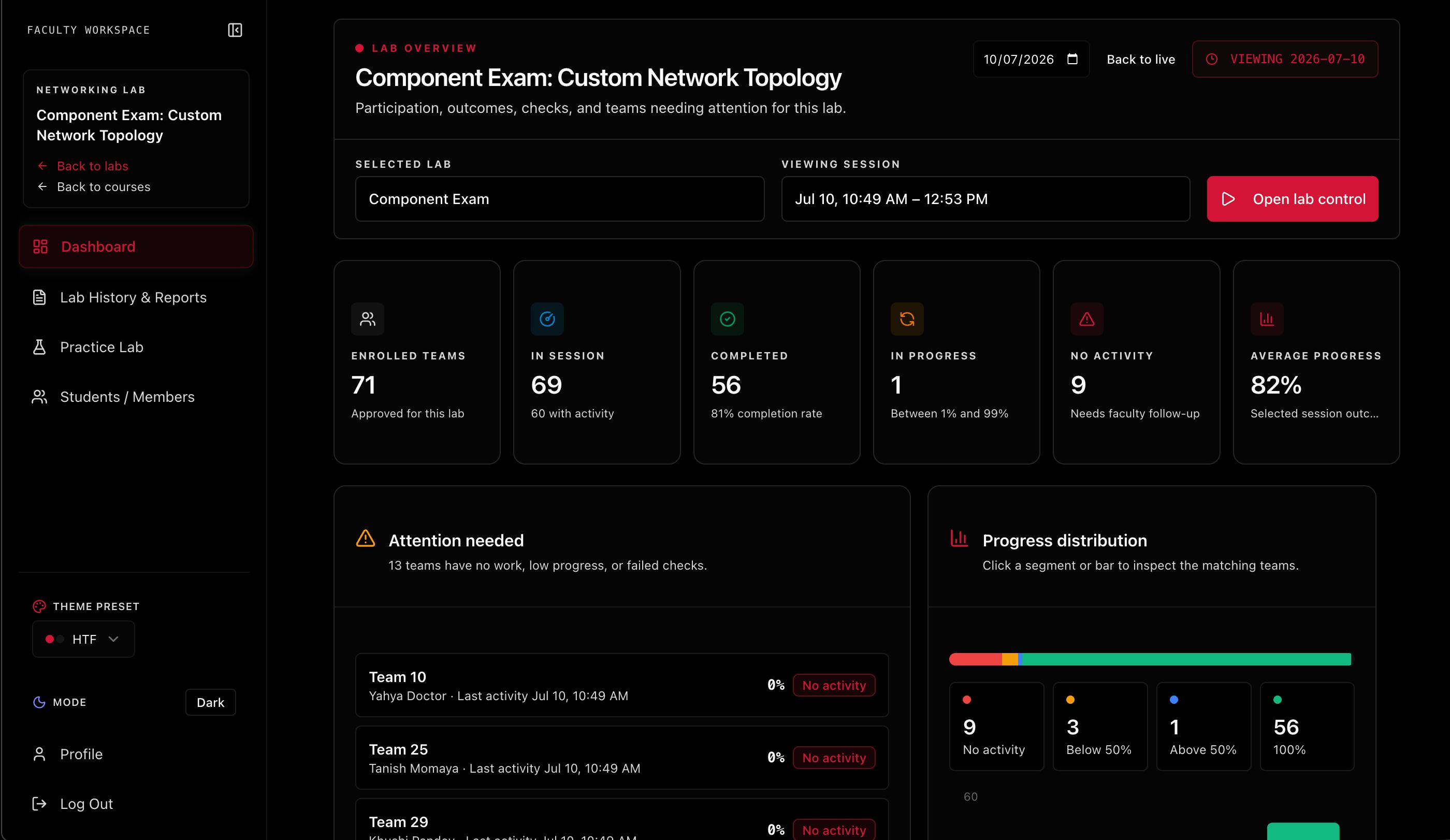
Lab Overview
Lab status, team participation and progress at a glance.
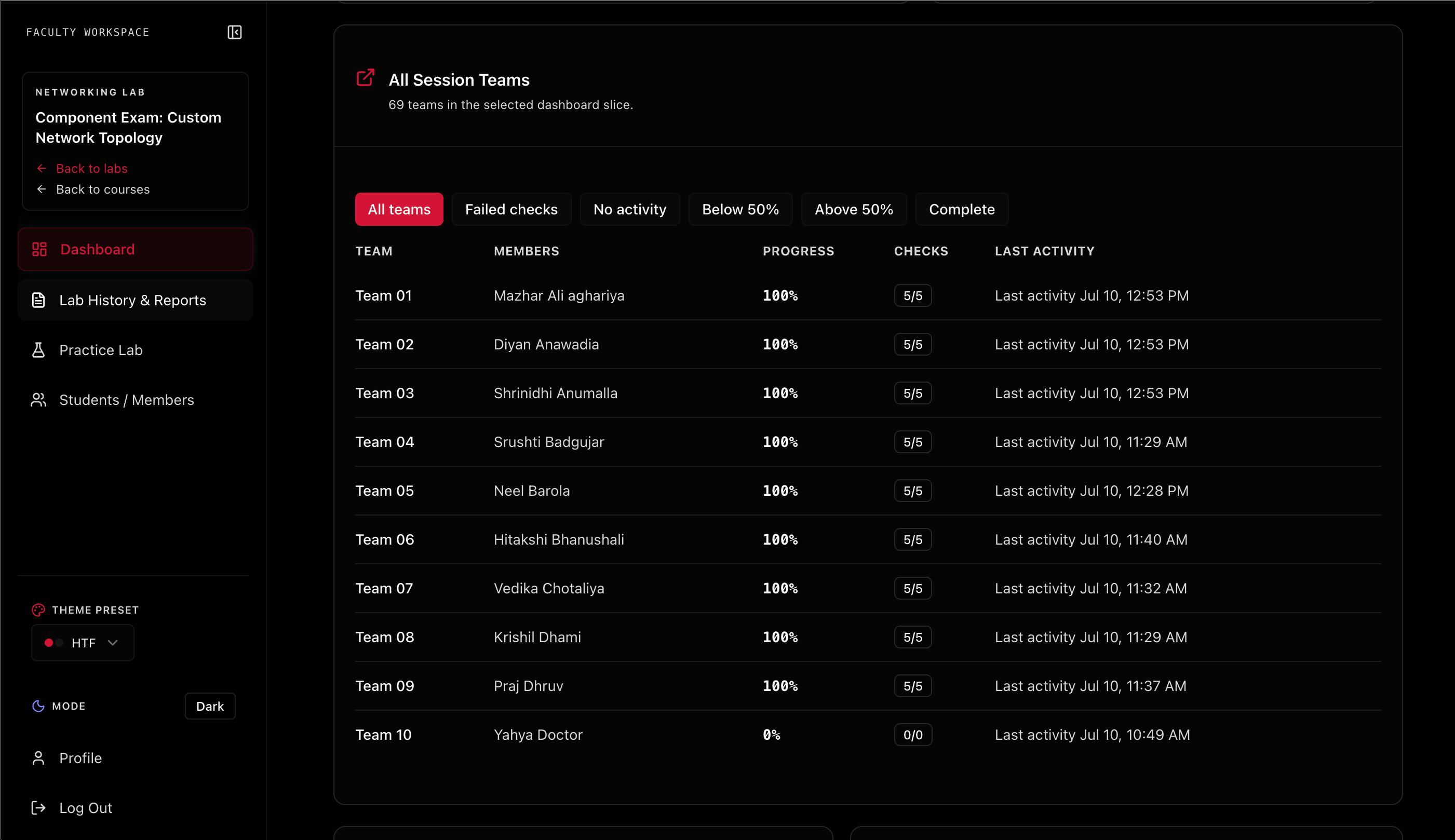
Session Teams
Every team, member, progress percentage and validation check in one view.
Where it stands today, honestly
Not every subject is equally built out yet, and we’d rather say that plainly than have you find out during onboarding. Computer Networks and Digital Forensics & Incident Response have been tested in a live pilot at SAKEC. DevOps/DevSecOps is scheduled for the next validation phase. Additional domains are developed against real institutional demand rather than in advance of it.
How a deployment actually runs
Deployments are scoped around the subject an institute teaches rather than sold as one fixed bundle. In practice that’s a six-step process, and it starts with what you already teach, not with what we’ve already built.
Choose & Understand
You tell us which subject(s) you need. We review your syllabus, batches and existing infrastructure.
Plan
Together with faculty, we agree which labs go into the deployment.
Deploy
We configure the workspace, faculty access, student batches and lab environments.
Run
Faculty and students use the labs during scheduled practical sessions.
Improve
Feedback and usage data feed back into the labs and workflows during the term.
Review
At the end of the term, we review outcomes and scope what comes next.
If you want to see how this compares with the tools your department may already be using — Packet Tracer, IIT Virtual Labs, a traditional physical lab — the Computer Networks comparison is the place to start.